How Long Can Instagram Reels Be? Maximum Length Guide
Contents
- Key Takeaways
- What Is the Maximum Instagram Reels Length?
- Has Instagram Increased the Reel Length Limit?
- How Long Should Instagram Reels Be for More Views?
- Does Reel Length Affect the Instagram Algorithm?
- Can You Upload Long Videos as Reels?
- Reels for Creators vs. Reels for Businesses
- Educational Reels: How Long Is Too Long?
- Storytelling Reels: Finding the Right Pace
- Product Promotion Reels: Length That Converts
- Common Reel Length Mistakes
- Tips to Improve Reel Performance
- Future Trends: Where Is Reel Length Heading?
- Watch Time, Retention, and Completion Rate Explained
- Hook Strategies for Every Reel Length
- How Do You Check Your Account's Reel Length Limit?
- Summary Box
- Final Thoughts
How long can Instagram Reels be? If you've searched this question recently, you've probably noticed something frustrating: every article seems to give a different answer. Some say 90 seconds. Some say 3 minutes. Some say 15 or even 20 minutes. None of them are exactly wrong — they're just describing different pieces of a limit that has changed multiple times and rolls out unevenly across accounts.
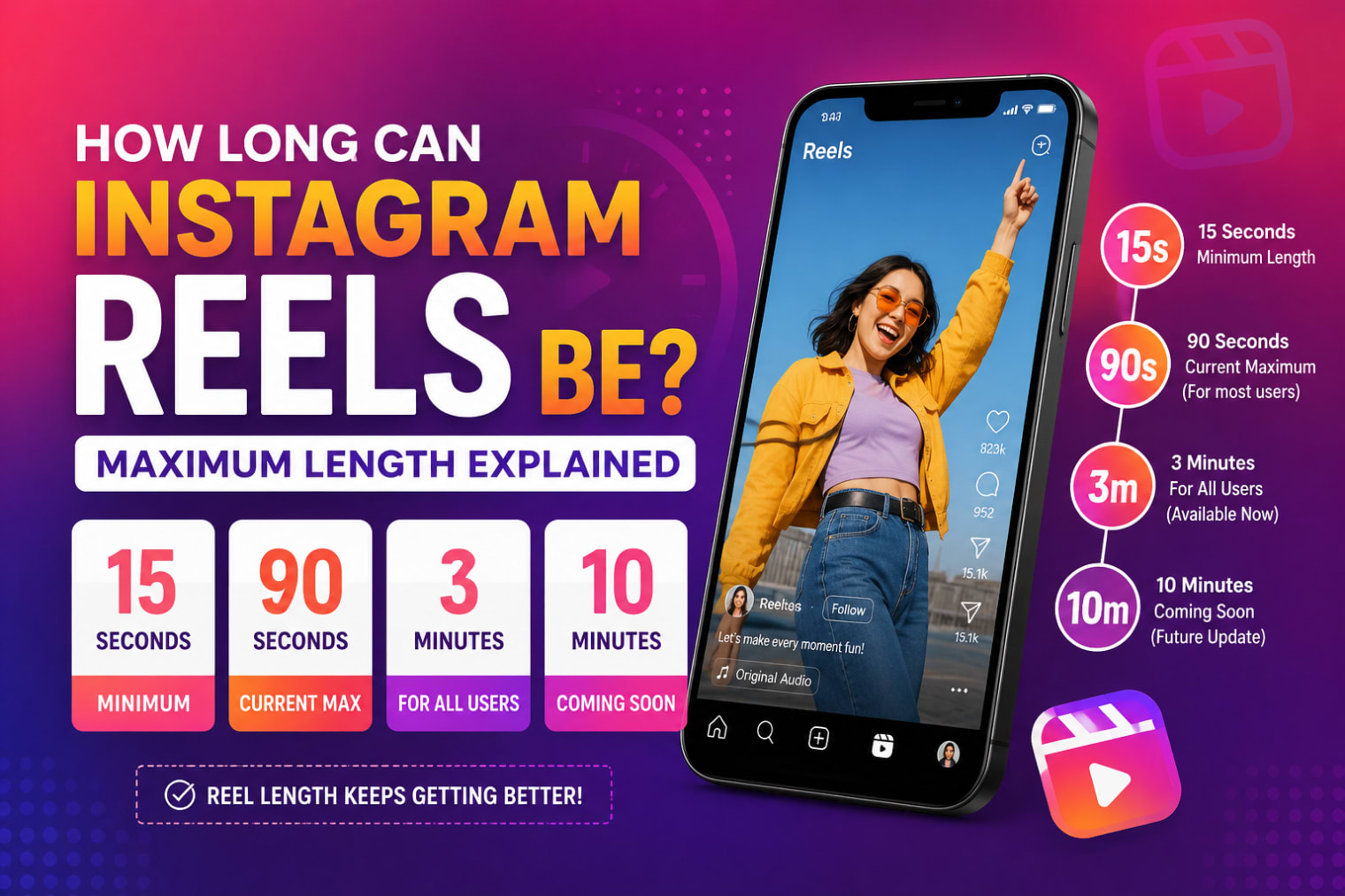
Here's the short version: Instagram Reels can run anywhere from 3 seconds up to 20 minutes in 2026, depending on how you create the Reel and what features your specific account has access to. Most people recording directly in the app see a cap around 3 minutes, while uploading a pre-edited video from your camera roll unlocks longer durations — up to 15 minutes for many accounts, with a 20-minute option rolling out to select creators and businesses.
This guide breaks down exactly what those limits mean, how they've changed over time, and — more importantly — how long your Reels should actually be if you want people to watch them.
Key Takeaways
- The minimum length for an Instagram Reel is 3 seconds.
- Recording directly in the Reels camera typically caps most accounts around 3 minutes.
- Uploading a pre-recorded video from your camera roll allows longer durations, up to 15 minutes for many accounts.
- A 20-minute upload option is rolling out to select creators and business accounts as of 2026.
- Instagram's algorithm still favors short, high-retention Reels for discovery — the maximum length and the best length are two very different things.
- Reels longer than about 3 minutes are rarely recommended to non-followers, meaning they mostly reach your existing audience.
What Is the Maximum Instagram Reels Length?
The honest answer is: it depends on your account and how you're creating the Reel. Instagram doesn't apply one single length limit anymore — it applies different limits depending on the creation method.
- Recording in the Reels camera: Most accounts can currently record up to 3 minutes directly in the app.
- Uploading from your camera roll: Many accounts can upload pre-edited videos up to 15 minutes long.
- Extended limit: A 20-minute maximum is rolling out to select creator and business accounts, positioning Reels closer to a YouTube-style long-form option.
- Minimum length: Every Reel must be at least 3 seconds long, regardless of how it's created.
If your app shows a different number than what a friend or competitor sees, that's not a bug. Instagram rolls out length increases gradually, account by account, rather than flipping a single global switch. Two people posting on the same day can genuinely see different maximums.
Has Instagram Increased the Reel Length Limit?
Yes, repeatedly. Reels launched in August 2020 with a strict 15-second cap, designed as a direct response to TikTok. Since then, Instagram has extended the limit several times:
- 2020: 15 seconds at launch
- 2021: Extended to 30 seconds, then 60 seconds
- 2022: Extended to 90 seconds
- 2024–2025: Extended to 3 minutes
- Late 2025 into 2026: Upload limits extended further, up to 15 minutes for many accounts, with a 20-minute option beginning to roll out to select accounts
Each increase followed a similar pattern: creators asked for more room for tutorials, storytelling, and educational content, and Instagram responded by loosening the ceiling — while continuing to push shorter Reels harder in Explore and recommendations.
How Long Should Instagram Reels Be for More Views?
This is really the question that matters most, and it's a completely different question from "what's the maximum length." The technical ceiling and the ideal length for growth are not the same thing, and treating them as interchangeable is one of the most common mistakes creators make.
Data across the industry consistently points to the same pattern: shorter Reels, generally in the 7 to 30-second range, tend to achieve the highest average engagement rates. Reels in the 15 to 60-second range work well for tutorials and product showcases, while anything past 90 seconds starts losing viewers steadily unless the content is genuinely gripping from the first few seconds.
Quick answer for featured snippets: The ideal Instagram Reel length for most content is 15 to 30 seconds, since Instagram's algorithm favors videos with high completion rates, and shorter Reels are far more likely to be watched all the way through.
Does Reel Length Affect the Instagram Algorithm?
Yes, but not in the way most people assume. Length itself isn't the ranking factor — completion rate and retention are. A longer Reel isn't automatically penalized, but it is statistically much harder to get someone to watch all the way through, and that drop-off directly hurts how far the algorithm pushes it.
Here's the practical reality: Instagram's discovery system still prioritizes short-form video over long-form. Reels longer than roughly 3 minutes are rarely recommended to people who don't already follow you. They tend to stay inside your existing follower graph rather than getting pushed out through Explore and the main Reels tab. If your goal is growth and reaching new people, that's a critical detail — a 15-minute Reel might work beautifully for an already-engaged audience, but it's not going to be your discovery engine.
Can You Upload Long Videos as Reels?
Yes. If you upload a pre-edited video from your camera roll rather than recording live in the app, Instagram allows significantly longer durations — up to 15 minutes for many accounts, and up to 20 minutes for accounts with the extended limit rolled out. Any video under roughly 15 minutes is generally categorized and displayed as a Reel automatically, rather than needing a separate video format.
This matters for creators who already produce longer-form content elsewhere — a YouTube tutorial, a podcast clip, a webinar recording — since it means that content can often be repurposed directly into Reels without heavy re-editing, as long as it's formatted vertically.
Pro tip: If you're posting a longer Reel, treat the first 3 seconds as its own separate mini-Reel. That's the window where most viewers decide whether to keep watching or scroll away, regardless of how long the full video actually is.
Reels for Creators vs. Reels for Businesses
Creators and businesses often approach Reel length differently, and honestly, they should.
Creators chasing growth and new followers generally benefit from staying shorter — the 15 to 60-second range tends to perform best because it's optimized for discovery and being pushed to non-followers. If you're building an audience from a smaller base, this is where most of your Reel strategy should live.
Businesses and brands often have more room to experiment with mid-length Reels, especially for product demonstrations, behind-the-scenes content, and educational posts aimed at an audience that already follows them. Since businesses frequently care as much about nurturing existing customers as acquiring brand-new ones, a 60 to 90-second Reel showing a product in detail can genuinely outperform a shorter, flashier one — as long as the retention holds up.
If growth and visibility are the priority regardless of account type, pairing consistent short-form content with a foundation of real engagement — through things like Instagram followers and Instagram likes — can help a profile look more established while the content strategy itself does the long-term work of building genuine reach.
Educational Reels: How Long Is Too Long?
Educational content is the category where length questions come up most often, because there's a real temptation to cram in as much value as possible. The problem is that value only counts if people actually stick around to receive it.
For educational Reels, the sweet spot is usually 30 to 90 seconds for single-tip content, and up to 3 minutes for slightly deeper explanations — assuming you're using clear structure (like numbered points or on-screen text) to keep viewers oriented. Beyond 3 minutes, you're generally better off splitting the content into a short series of Reels rather than one long one, both for retention and for discoverability, since each Reel in a series gets its own shot at reaching new viewers.
Storytelling Reels: Finding the Right Pace
Storytelling content has more flexibility than tutorials because pacing and emotional hooks matter more than information density. A well-paced 60 to 90-second story with a clear beginning, twist, and payoff will almost always outperform a rambling 3-minute one, even if the 3-minute version technically contains "more" content.
The key with storytelling Reels is planting a hook in the first 3 seconds that creates a specific question in the viewer's mind — "wait, how does this end?" — and then resolving it before attention drops off. If you notice your storytelling Reels losing viewers around the same timestamp consistently, that's usually a signal the pacing needs tightening, not that the story itself was wrong.
Product Promotion Reels: Length That Converts
Product Reels live or die on clarity, not runtime. The goal isn't to explain everything about the product — it's to make someone curious enough to tap your profile or link. That usually happens (or doesn't) within the first 10 seconds.
A 15 to 30-second product Reel that clearly shows what the product is, what it does, and why it matters will typically convert better than a 90-second Reel that walks through every single feature. Save the deeper feature walkthroughs for content aimed at people who are already close to a purchase decision — retargeted audiences, warm followers, or people who've engaged with previous posts.
Common Reel Length Mistakes
- Assuming longer automatically means more value. Viewers judge value by what they actually watch, not by runtime.
- Front-loading a slow intro. If your hook doesn't land in the first 3 seconds, length becomes irrelevant — most viewers are already gone.
- Using the maximum length "because you can." Just because your account unlocked a 15 or 20-minute upload option doesn't mean every Reel should use it.
- Ignoring retention graphs. Instagram's own analytics show exactly where viewers drop off — most creators never check this, and it's often the single most useful piece of data available.
- Treating every content type the same. A trend Reel and an educational Reel shouldn't be the same length just because they're both "Reels."
Tips to Improve Reel Performance
- Hook viewers immediately. Whatever the length, the first 3 seconds decide whether the rest of the video gets watched at all.
- Match pacing to platform behavior. Instagram users scroll fast — don't waste the opening seconds on branding or a slow build-up.
- Use on-screen text for retention. Especially in longer or educational Reels, text keeps viewers oriented even if they're watching with sound off.
- Watch your own analytics, not just industry averages. Your specific audience might respond differently than the "typical" data suggests.
- Test different lengths deliberately. Post a few short Reels and a few longer ones on similar topics, then compare completion rate and reach, not just raw view count.
- Don't ignore the loop effect. Extremely short Reels (3-5 seconds) that loop seamlessly can rack up unusually high watch time relative to their length, since viewers often watch them multiple times without realizing it.
Future Trends: Where Is Reel Length Heading?
Instagram's pattern over the past several years has been steady expansion — from 15 seconds at launch to a 20-minute ceiling rolling out in 2026. That trend, combined with competitive pressure from TikTok's longer video options and YouTube Shorts, suggests the maximum length ceiling will likely keep climbing.
That said, Instagram has been consistent about one thing through every expansion: the platform's own leadership has repeatedly reaffirmed that Reels remains focused on short-form video for discovery, even as the technical maximum grows. The practical takeaway for creators is that chasing the newest, longest limit is rarely the smart move. The maximum will likely keep expanding — the algorithm's preference for short, high-retention content is far less likely to change anytime soon.
Watch Time, Retention, and Completion Rate Explained
These three terms get thrown around a lot, often interchangeably, but they actually measure different things — and understanding the difference helps explain why length alone doesn't determine performance.
- Watch time is the total amount of time people spend watching your Reel, added up across all viewers. A 3-minute Reel watched halfway by many people can generate more total watch time than a 15-second Reel watched fully by the same number of people.
- Retention refers to how viewers behave throughout the video — specifically, where they drop off. A retention graph showing a steep drop in the first 3 seconds tells a very different story than one showing a gradual decline throughout.
- Completion rate is the percentage of viewers who watch your Reel all the way to the end. This is often the most influential metric for shorter Reels, since a high completion rate is a strong quality signal to the algorithm.
Here's why this matters for length decisions: a 10-second Reel with an 80% completion rate is, in the algorithm's eyes, a much stronger signal than a 2-minute Reel with a 5% completion rate — even though the longer Reel technically generated more total watch time. This is exactly why shorter Reels so often outperform longer ones for reach, even when the longer content is genuinely higher quality.
Hook Strategies for Every Reel Length
Regardless of how long your Reel ends up being, the opening moment does the heaviest lifting. Here are hook strategies that work across different lengths:
- For short Reels (under 15 seconds): Open directly on the payoff or the most visually interesting moment. There's no time for a slow build.
- For medium Reels (15-90 seconds): Open with a specific question or promise — "here's why your bread isn't rising" — that gives viewers a clear reason to keep watching.
- For long Reels (90 seconds+): Use a hook in the first 3 seconds, then plant a second "micro-hook" every 20 to 30 seconds throughout the video to re-capture attention before it drifts.
- For educational or tutorial Reels: State the specific outcome viewers will get by the end, right at the start — "3 mistakes killing your Reel reach" tells people exactly what they're staying for.
Common thread across all of these: viewers decide whether to keep watching almost immediately, and that decision resets every 20-30 seconds in longer content. Treat every segment of a longer Reel like its own mini-hook, not just the opening.
How Do You Check Your Account's Reel Length Limit?
Since limits roll out gradually and unevenly, the most reliable way to know your actual limit isn't reading an article — it's checking directly inside the app.
- Open Instagram and tap the plus icon to start a new post.
- Select Reel from the options.
- Look at the bottom of the camera screen for the length selector (usually showing options like 15s, 60s, 3m).
- Tap through the options to see the longest duration currently available on your account.
- If you need more time than your in-app limit allows, edit your video in a separate app and upload it from your camera roll instead, where longer durations are typically available.
If your limit seems lower than what you've read about, that's expected — not a bug. Instagram's gradual rollout means account age, activity level, region, and account type (personal, creator, or business) can all influence when a specific account receives an updated limit. Checking periodically, especially before planning a longer-form Reel campaign, is the most reliable approach.
Pro tip: Business and creator accounts sometimes receive extended length options before standard personal accounts. If you're serious about long-form Reels and haven't already switched to a creator or business profile, that's worth considering — both for the potential length benefit and for the analytics access that comes with it.
Summary Box
- Minimum Reel length: 3 seconds.
- In-app recording: most accounts capped around 3 minutes.
- Camera roll uploads: up to 15 minutes for many accounts, 20 minutes for select accounts.
- Best length for growth and discovery: 15-30 seconds.
- Reels over roughly 3 minutes mostly reach existing followers, not new audiences.
- Completion rate and retention matter more to the algorithm than raw length.
- Match length to content type: short for trends and hooks, longer only for warm-audience storytelling or education.
Final Thoughts
The maximum length of an Instagram Reel keeps climbing — from 15 seconds back in 2020 to a 20-minute ceiling rolling out to select accounts in 2026. But the number that actually matters for growth hasn't moved nearly as much: short, high-retention Reels, generally in the 15 to 30-second range, remain the most reliable path to reaching new audiences.
Use the longer options when they genuinely serve the content — deep tutorials, storytelling, repurposed long-form video for an established audience. But for most Reels, especially ones aimed at growth and discovery, shorter is still the smarter bet. Building real momentum on Instagram usually comes down to combining that kind of consistent, well-paced content with a strong foundation — something IGLikes.io's followers and likes services can help support while your content strategy does the long-term work of turning viewers into a genuine audience.
Frequently Asked Questions
How long can Instagram Reels be in 2026?
Instagram Reels can run from 3 seconds up to 20 minutes, depending on your account and how the Reel is created. Recording directly in the app typically caps most accounts around 3 minutes, while uploading a pre-edited video allows longer durations.
What is the minimum length for an Instagram Reel?
Every Reel must be at least 3 seconds long. Anything shorter won't be categorized or uploaded as a Reel.
What is the best Instagram Reel length for engagement?
Most data points to 15 to 30 seconds as the sweet spot for engagement, since shorter Reels are far more likely to be watched all the way through, which directly boosts algorithmic reach.
Can I record a longer Reel directly in the Instagram app?
Most accounts can currently record up to 3 minutes directly using the in-app Reels camera. For longer durations, you'll typically need to upload a pre-edited video from your camera roll instead.
Does a longer Reel get less reach than a shorter one?
Not automatically, but longer Reels are statistically harder to get full completion rates on, and Instagram's discovery system tends to favor high-retention, shorter content when recommending Reels to people who don't already follow you.
Why does my Instagram account show a different Reel length limit than my friend's?
Instagram rolls out length increases gradually rather than all at once, so it's completely normal for two accounts to see different maximum lengths at the same time.
Is there a difference between recording limits and upload limits on Instagram Reels?
Yes. Recording directly in the app usually has a shorter cap (commonly around 3 minutes), while uploading a pre-recorded video from your camera roll typically allows a much longer duration.
How do I edit a long video to fit Instagram Reels?
Edit your video in your preferred editing app first, export it in a vertical 9:16 format, then upload it directly from your camera roll rather than recording it live inside Instagram's Reels camera.
Why is my Reel not showing up as a Reel after uploading?
This usually happens when a video exceeds the platform's current length threshold for Reels categorization, or when the aspect ratio isn't vertical. Check that your video is under the applicable length limit and formatted correctly.
Should businesses post longer or shorter Reels?
It depends on the goal. For reaching new customers, shorter Reels in the 15 to 60-second range typically perform better. For nurturing existing customers with deeper product or educational content, slightly longer Reels can work well, especially when paired with a consistent overall content strategy.
Do Instagram Reels over 3 minutes get pushed to new audiences?
Rarely. Reels longer than about 3 minutes are generally not recommended heavily to non-followers, meaning they tend to reach your existing audience rather than driving new discovery.
Does the aspect ratio matter as much as the length?
Yes, arguably more for basic eligibility. Reels need to be vertical, ideally in a 9:16 ratio at 1080 x 1920 pixels. A perfectly-timed Reel uploaded in the wrong aspect ratio can still underperform simply because it doesn't fill the screen the way Instagram's Reels format expects.